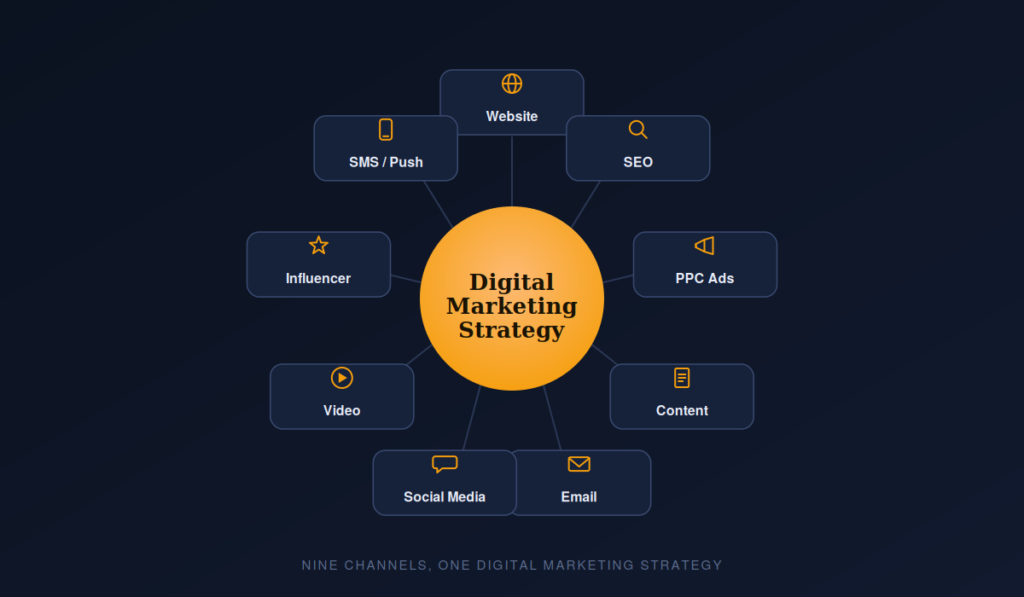
A strong digital marketing strategy is what separates brands that grow steadily online from ones that throw money at trends and hope something sticks. Marketing has moved almost entirely online, and it keeps shifting. The brands winning attention today aren’t necessarily spending the most. They’re spending smarter, on the right channels, with the right message, at the right moment.
This guide breaks down what a digital marketing strategy actually involves, the channels that matter most right now, and how to measure whether yours is working.
What Is a Digital Marketing Strategy?
At its core, a digital marketing strategy is a plan for promoting your brand, product, or service through internet-connected channels. That includes your website, search engines, social platforms, email, apps, and paid ads, used instead of (or alongside) traditional media like TV, radio, or print.
What sets it apart from a traditional marketing plan isn’t just where it happens, but how it works.
- It’s targetable. You can reach a specific age group, location, interest, or even someone who already visited your site, rather than broadcasting to everyone.
- It’s measurable. Every click, view, and purchase can be tracked, so you know what’s actually driving revenue instead of guessing.
- It’s adjustable in real time. A campaign that’s underperforming can be paused or tweaked the same day, with no waiting for the next print run or ad slot.
Channels Every Digital Marketing Strategy Should Include
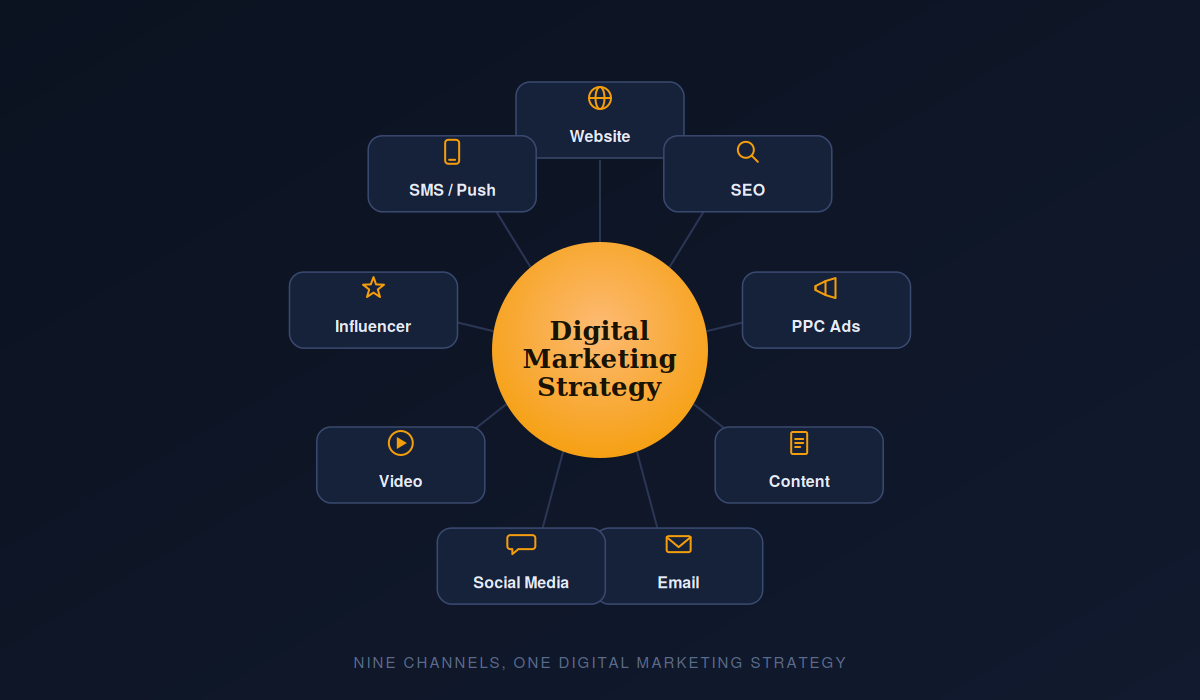
Most effective channels work together rather than alone. Here’s how each one fits into a broader digital marketing strategy.
1. Your Website
Your site is the foundation everything else points back to. Paid ads, social posts, and emails all eventually funnel people to a page that needs to load fast, work on mobile, and make it obvious what to do next. A beautiful site that’s slow or confusing loses customers before they convert.
2. Search Engine Optimization (SEO)
SEO structures your site and content so search engines rank it higher for relevant queries. Following established search ranking guidance helps ensure your pages are built to be found in the first place.
Unlike paid ads, the traffic you earn through SEO keeps coming without an ongoing per-click cost. That makes it one of the best long-term investments in any digital marketing strategy, even though it takes longer to pay off.
3. Pay-Per-Click (PPC) Advertising
PPC lets you buy visibility instantly. Platforms like Google Ads and Meta Ads let you target people by what they’re searching for, their demographics, or their interests, and you only pay when someone actually clicks.
It’s the fastest way to test a message or get in front of a new audience while your organic efforts build.
4. Content Marketing
Instead of directly pitching a product, content marketing earns attention through useful or entertaining material. Guides, videos, tools, and articles pull people in because they solve a problem the audience already has.
The sale comes later, after trust is built, which is why content sits at the center of most modern digital marketing strategy planning.
5. Email Marketing
Despite being one of the oldest digital channels, email still delivers some of the highest returns of any marketing dollar. You already own the list, so no platform algorithm decides whether your message gets seen.
The key is using it to nurture a relationship, not just to push promotions.
6. Social Media Marketing
Social platforms now serve double duty. They build brand awareness and act as a direct sales channel through shoppable posts, DMs, and in-app checkout.
The platforms that matter shift over time, so the channel itself matters less than picking the one or two where your actual audience spends time.
7. Video Marketing
Short-form video has become the default way many people discover new products, especially on TikTok, Instagram Reels, and YouTube Shorts.
Video works best when it’s tied into a broader strategy, paired with SEO and social distribution, rather than treated as a standalone effort.
8. Influencer & Affiliate Partnerships
Rather than buying ad space, brands pay creators and partners to promote products to audiences they’ve already built trust with. This works particularly well for products that benefit from a personal recommendation or demonstration.
9. SMS and App Push Notifications
Text and push messages have some of the highest open rates of any channel simply because they land directly on someone’s lock screen.
Used sparingly, for time-sensitive offers or order updates, they’re highly effective. Overused, they drive opt-outs fast.
How to Know If It’s Working: Key Metrics
Tracking the right numbers is what separates marketing that compounds over time from marketing that just burns budget. These are the numbers that show whether your digital marketing strategy is actually paying off.
| Metric | What It Tells You |
|---|---|
| Click-through rate (CTR) | What percentage of people who saw your ad or link actually clicked it |
| Conversion rate | What percentage of those clicks turned into a sale, signup, or other goal |
| Customer acquisition cost (CAC) | What you’re spending, on average, to win one new customer |
| Website traffic | How many people are reaching your site, and from where |
| Engagement rate | How much your audience is interacting with your content vs. just scrolling past |
No single metric tells the whole story. A high CTR with a low conversion rate usually means the ad is attracting the wrong audience, not that the campaign is “working.”
Challenges Shaping Digital Marketing Strategy in 2026
- Channel fragmentation. New platforms and formats appear constantly. Spreading a budget too thin across all of them usually performs worse than mastering two or three.
- Rising attention costs. As more brands compete for the same scroll, the cost to capture genuine attention keeps climbing, making organic trust-building (SEO, content, community) more valuable, not less.
- Data and privacy shifts. Evolving privacy regulations and the phase-out of third-party tracking mean marketers increasingly need first-party data, like email lists, app accounts, and loyalty programs, to target effectively.
Building a Digital Marketing Strategy That Works
There’s no universal “best” channel. The right mix depends on what you’re selling, who you’re selling to, and how long your sales cycle is. A B2B software company will lean far more on content marketing, SEO, and email than a fast-fashion brand thriving on short-form video and influencer drops.
The common thread across every channel that works: a clear understanding of the customer, content that earns attention rather than demanding it, and a willingness to measure results honestly and adjust.

Digital Marketing Strategist at Growstrom
Prashant Kumar is a Digital Marketing Strategist at Growstrom, specializing in SEO, Local SEO, Google Ads, Meta Ads, and digital marketing strategies. He works on practical search optimization and lead-generation strategies to help businesses improve their online visibility, website traffic, and qualified leads.